Sunday, January 18, 2015
Please visit the new location of my blog on bethbooram.org
I have moved my blog to my personal web site. Please visit me there to read new blog posts, hear about my new books and register for the Starting Something New retreats.

Friday, January 2, 2015
Word-of-the-Year 2015: REST
I’ve known for a couple of weeks what my word-of-the-year
needed to be about but actually landing on the precise word has been difficult.
The idea I wanted to convey with this linguistic focal point for the year was
the attitude of open-handed trust in God; a letting go of striving,
willfulness, driveness as I surrendered all outcomes of my life and work to
God. I couldn’t quite land on a word until I processed it with my spiritual
director and he suggested the word “rest.”
My immediate reaction when I heard the word “rest” was one of dread and resistance. That kind of response is often a sign of exactly where I need to pay attention and open myself more fully to God. In the world of spiritual direction, we understand that interior resistance, the reaction of discomfort and stubbornness, is often fertile ground for the work of the Spirit. I laughed out loud when Jim presented “rest” as a word to prayerfully consider, noting my resistance and admitting that I wished I hadn’t asked for his help.
Why rest? I had really wanted a word that captured the idea of planting and waiting for harvest; initiating and leaving the results to God. The truth is planting and initiating are native to my personality. I am a doer, goal-setter, hard worker and perseverer. What I struggle most with is living open-handedly toward the outcome of my work and initiative. I want to get in there and help God out; control the process or assist God in the work and results. Resting is exactly the posture I need to cultivate.
For me to choose this word rest is not to suggest that
this next year will be a year-long holiday. Rather, I’m eager for this word to
become my interior posture of “holy indifference,” a phrase used by St.
Ignatius to describe an attitude where I leave all consequences of my life to
God and trust the Faithfull One with the harvest. Here’s a parable of Jesus, in
my own paraphrase, that captures the way in which I hope to live this out.
“Here is what the kingdom of God is
like: a woman who throws seeds onto the earth. Day and night, as she works and as she rests, the seeds sprout and climb out into the light, even though
she doesn’t understand how it works. It’s as though the
soil itself produced the grain somehow—from a sprouted stalk to ripened
fruit. But however it happens, when she sees that the
grain has grown and ripened, she gets her sickle and begins to cut it because
the harvest has come.” (The Voice) Mark 4:26-29
The sower in this case does what she can, planting and then resting, trusting the nature of soil, sun, rain and atmosphere to do its generative work. This next year as my new book Starting Something New: Spiritual Direction for Your God-given Dream is released and I begin a tour of retreats on the book, I have clear instructions from God that I am to “rest” in him and resist the temptation to strive for results. Even as I pray the word “rest,” it resonates deeply and with rightness in me in terms of where I am these days and where God is shaping me.
How about you? Have you found the word for 2015 that could be your North Star? A word that will help navigate what God is inviting you to be, do or grow toward? Happy New Year as you orient yourself to that star and set sail into this new year!
The sower in this case does what she can, planting and then resting, trusting the nature of soil, sun, rain and atmosphere to do its generative work. This next year as my new book Starting Something New: Spiritual Direction for Your God-given Dream is released and I begin a tour of retreats on the book, I have clear instructions from God that I am to “rest” in him and resist the temptation to strive for results. Even as I pray the word “rest,” it resonates deeply and with rightness in me in terms of where I am these days and where God is shaping me.
How about you? Have you found the word for 2015 that could be your North Star? A word that will help navigate what God is inviting you to be, do or grow toward? Happy New Year as you orient yourself to that star and set sail into this new year!
Sunday, November 2, 2014
This I Believe: Hiddenness is the Way toward Interior Freedom

I've known for some time that the best description I can give for my spiritual quest right now is the desire for interior freedom. Below is an excerpt from a book called Fire of Mercy and edited by my husband. As I read it this morning, it resonated so deeply with me and what I know to be true about my spiritual journey. I offer it as a meditation, hoping that it will speak to you of invitation and intimacy.
"Left to our instincts, we will never be anything but pretenders, especially in the realm of religion.
Jesus, for his part, prescribes the way to the heart,
which begins with withdrawal from finding approval in the world around us.
And so he says, "Go into your storeroom, lock your
door, pray to your Father."
My own feet must come back into my house. My own hand
must lock the door. My own heart must pray in secret. Once I have entered this
inner chamber, I can go out to find God everywhere, but not before, because in
fact the God I encountered deep in my interior silence will show me his
presence in the cosmos. Until then I will be seeing only reflections of my own
desires and hearing echoes of my own inner noise.
In that way, no one else’s experience of God can be
imitated so as to become my own.
The true God abides in hiddenness.
Inside comes before outside, center before periphery,
hiddenness before manifestation, since all of the latter are “generated” by the
former.
One of God’s truest names is, *“the One who sees in hidden
places.” In a way we could say that God only sees in hidden places, that
consequently the actions and attitudes of pretenders in public places are not
seen by God because they are not real.
Hiddenness is here a crucial criterion for genuineness,
for reality, for being in fact. How horrible not to be seen by God, to live in
such a way that our lives are mere fleeting ghosts before him! Our vanity and
all our chasing the wind are not so much evils as they are insubstantial: to
the point of rendering God blind to them.
Hiddenness, solitude, and silence have the effect, so to
speak, of gathering up the scattered: atoms of our being and kneading them into
an image recognizable in the eyes of God.
The Father has made me a steward over myself, and
interiority is the space where I do the work assigned me.
Now, the deepest part of the work assigned me is to seek
for the Face of God even as he himself is forever seeking my face, my
true-identity.
In actuality, God has already found me, but I cannot find
him until I come home into myself.
No other human work can be successful unless it can be
traced back to this essential activity that is purely interior: seeking the
Face of God so as to abide in its presence with the deepest part of my being.
The call to do this constitutes human identity."
Fire
of Mercy, Heart of the Word: Meditations on the Gospel According to Saint
Matthew: Vol. 1 by Erasmo Leiva-Merikakis
*This is the name Hagar gave to God when she encountered him in the wilderness. The image is of Hagar with her son, Ishmael.
Saturday, September 20, 2014
Foreshadowing: What I discovered I wrote to David in his Senior High School Year Book
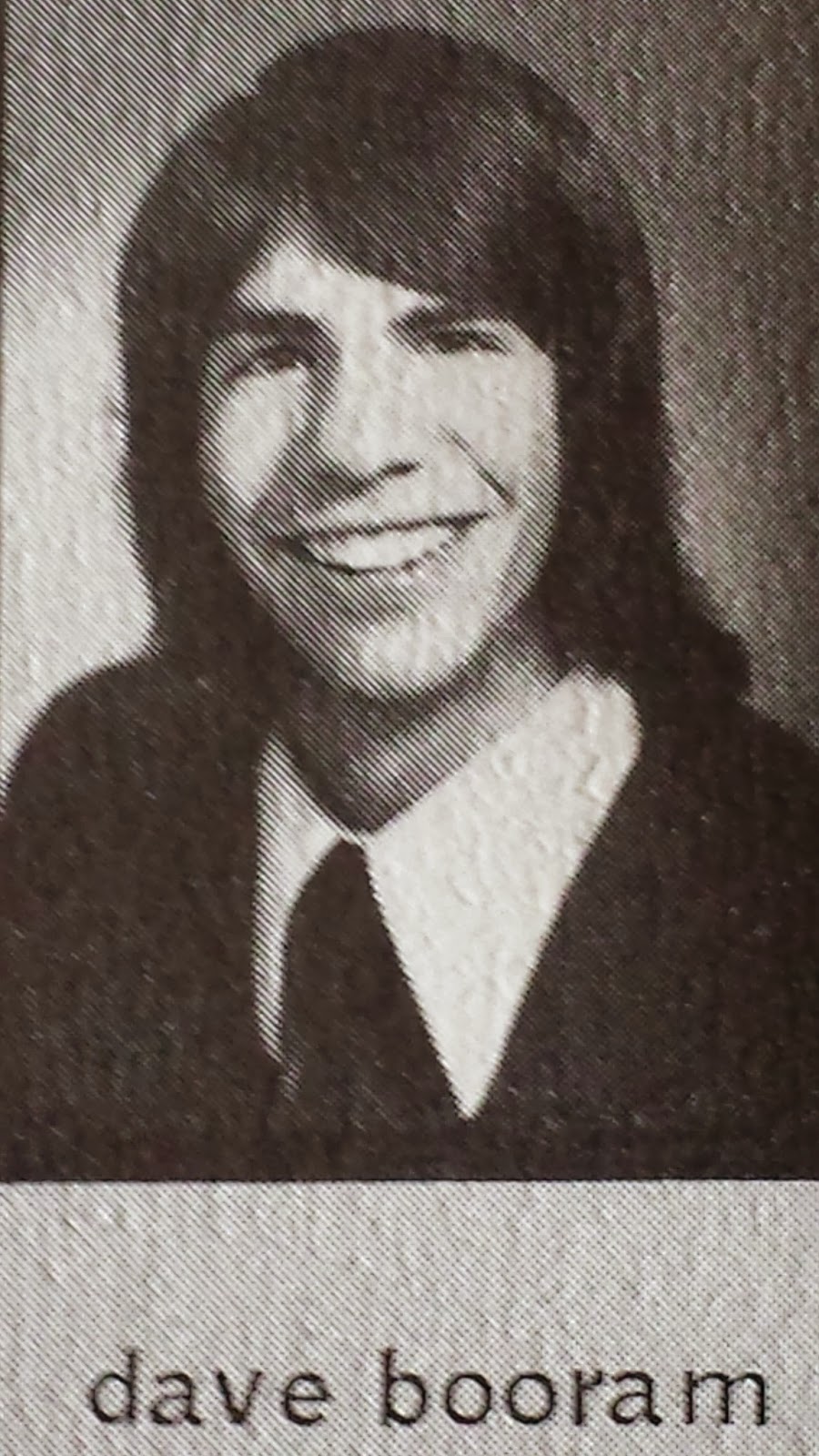
 Tonight is our 40th High School Class Reunion. I
realize that by admitting that I’m also admitting my age. Oh, well. Times like
these make me thoughtful and reflective of my life; of things past that with a
single prompt become a flood of once-buried memories.
Tonight is our 40th High School Class Reunion. I
realize that by admitting that I’m also admitting my age. Oh, well. Times like
these make me thoughtful and reflective of my life; of things past that with a
single prompt become a flood of once-buried memories.
David just came downstairs with his Southport High School Anchor
1974 Yearbook. He opened it to the back, to the page I had signed and what I
wrote to him in the spring of 1974. He made me read it out loud to him as we ate
breakfast. Keep in mind, we were only friends. Well, not “only.” He kissed me
once in high school. Only once. We had a sweet and significant friendship. But
we never really dated in high school.
Here’s a snippet of what I
wrote:
"David
Lee,
Well, David, we’ve come a long way
from 9th grade Christmas dances to serious walks in the park and a
real understanding of each other. Our closeness is different, you know. It’s
kind of a mutual smile that means I care and a kind of feeling you get when love
is near. You know you’re the one person I’m not worried about not seeing after
school is out. I feel like our togetherness is for eternity."
"Maybe I should be more realistic,
but I don’t want to ever be without you. I need you. I guess I can feel like since
we’re both going to IU, we will still have each other. But what’s after that? I
can feel dependent and confident with you around. I hope I give you the same
feeling of security. Dave Lee, remember band, Garfield Park, Pizza’s,
orchestra, the dance, being at my home talking, and memories like that. What I
remember more, though, is your face; especially your smile."
"I don’t feel like I’m saying what I
want to say. Maybe that’s another thing about close friends. They can’t really
say what they feel. So how’s this: My thoughts are with you. My thoughts are
deep and close and loving and warm and tender when you’re in my head and you’re
in my head a lot. Did you know that? You’re smile, I’ll remember always."
"Take
care, my friend. Remember, the Lord is coming.
Love in Christ, Beth Ann
McLaughlin"
When I read these words out loud, David called them “prescient.”
They read to me like foreshadowing; as though God, through the experience of me
grappling with words to express my feelings, was telling me something I knew in
my heart—but didn’t know. I read them today with amazement and gratitude for
God’s overwhelming grace in our marriage; in David and me finding one another,
choosing one another, and continuing to choose and prefer each other for more
than 35 years. God’s grace is the only word that explains what we’ve had
together.
As we celebrate with old friends and a few current friends
tonight, I have a mixture of nervousness and eager anticipation. I hope and
pray for meaningful connections with people who were part of such a formative
time in my life. I pray for moments of Llight like this one.
And by the way, I should add what I wrote as a P.S. in David’s
Yearbook: “In case of rapture, see you up there!! Maranatha!” A signature obviously
influenced by Hal Lindsey—a big sensation in those days :).
Saturday, August 30, 2014
What Happens within the Heart of God when we Cry?
 |
| Richard Sibbes (1577–1635) |
How we think of God, how we envision God’s disposition
toward us is said to be the most important thing about us. A puritan by the
name of Richard Sibbes was known for his vision of God as a life-giving,
generative, warming sun. And in like kind, Sibbes was known to emanate the same
disposition. He likened God’s love and goodness, his stance toward us, as “the
breast that loves to ease itself of milk.”
What an interesting and curious—unconventional—image. When I
read this description, I was instantly transported to memories of being a
nursing mother. I loved nursing my babies. It was a sweet and tender time. I
remember that deep and profound satisfaction of being able to provide
nourishment for them; the incredible sensation of my milk “letting down” at the
sound of their cry or the moment they began to “root” for the breast.
And it didn’t happen only with my babies. I could be in a grocery store minding my own business
and hear an infant start to whimper. More than likely his or her mother was
hurrying, trying to get the shopping done so that she could leave before she
had to stop and nurse her little one. I would hear the sound of that baby,
someone else’s baby, and it was not unusual to feel my milk begin to let down. Arms
pressed tightly across my chest, I would move along, as quickly as possible,
hoping not to leak milk.
As I read Sibbes description of the compassion and goodness
of God as a “breast that loves to ease itself of milk,” it occurred to me that that
is what happens within the heart of God when I cry; when you cry. His heart is
moved with compassion and desire; his milk “lets down”; his desire to respond
to our needs is aroused.
So why is it that far too often when we cry out for God, for
relief to have our needs met it doesn’t appear that God comes running? I’ve heard
half-a-dozen stories in the last ten days of people who are there. Right there.
Praying, asking God to show up, to help them know he’s there with them in the
darkness of their lives?
I’ve been there before, too—many times—times when I
desperately needed and wanted God to alleviate the pain of my life or the ache
in my heart. I wonder during those times how I can imagine the heart of God easing
itself of the milk of love and desire for me while my circumstances or
emotional experience or spiritual sense remains unaltered.
What I notice as I reflect is the “gap time” between my
crying out and God’s intervening; his milk letting down. Sometimes the gap
feels like eternity. Often it takes longer than I’d like. I want instant
gratification, like an infant who wants what he/she wants when he/she wants it!
I notice that God allows time to intensify my desire, ache, hunger. And I also
notice that I’ve never starved to death.
In due time, like a mother moved by her baby’s cry, I have
experienced the nurturing love of God fill my empty heart with love and warmth
and care. So, for me, this image of a nursing mother is compelling and a
hopeful way to think of God and what happens within God’s heart when I cry.
If you, like the individuals I have been with and stories I’ve
heard the last ten days, are feeling as though you are in the dark, groping
about and crying out to a God who seems indifferent, try contemplating God in
this way. Know that God meets you only within your lived experience--within the
reality of your life situation and your need for him. Imagine God’s heart
letting down with love and desire for you. That IS his disposition toward you—not
a waning mood or fleeting impulse. God is compassionate and responsive to you.
What you are experiencing is the “gap time” before his milk comes.
Wednesday, August 27, 2014
The Father-Daughter Dance

Today’s date will always be significant to me. It will
always take me back to one of the most vivid and unforgettable days of my life;
the day I witnessed death for the first time; the day I sat next to my dad’s
bed and watched him die. He’d been sick for a year and a half, surrendering, cell-by-cell,
to a wicked disease called pancreatic cancer. When we first found out about it,
I couldn’t believe it. It didn’t seem conceivable to me that I was old enough to
see one of my parents die. For 16 months, a heavy, melancholy canopy hung over our
lives; a canopy that came unhinged seventeen years ago today.
Interestingly, someone I met with today for spiritual direction shared a tender story about her dad. I know that my role as a spiritual director is to listen and provide helpful questions so that my directees can explore how God is at work in their lives. It is not my place to bring up memories of my own life that come to me. But in this instance, and because I know this person fairly well, I took a risk and asked if I might tell her about something her story caused me to remember. I mentioned that today is the anniversary of my dad's death and that when she was sharing, it immediately
brought to mind a long-forgotten memory of my very first Father-Daughter dance.
I was in fifth or sixth grade and enrolled in an etiquette class
called “Mrs. Gate’s Ballroom Dancing”—a kind of popular thing to do in the mid-1960’s.
The girls wore white, wrist-length gloves and white anklets with polished patent
leather shoes. (Or maybe hose, if you were really grown up.) I don’t recall what
the boys wore, but I’m pretty sure it included a neck tie.
At the beginning of class, we’d line up against the hallway
into the ballroom—girls on one side, boys on the other. Mrs. Gates stood at the
head of the line. She would turn, politely, to the girl, shake her hand and ask
her name. And then to the boy, shake his hand, and ask his name. And then she
would introduce the girl to the boy, we’d shake hands and say to each other, “It’s
very nice to meet you, _________.” And off we’d go, dance partners for the rest
of the class.
I remember that sometimes we’d look across the line of boys in
the hallway and count back to see who we would be paired with. There was one
particular boy that no one wanted to dance with and so we would squeeze in and
out of line to avoid that fate—a cruelty that makes me sad to think about today.
The culmination of all the weeks of practice
learning the fox trot and cha-cha was a special, end-of-class dance. This was a big
deal because everyone’s parents came and we dressed up and sat at round tables
with white table clothes and showed off to our parents our good manners and fancy dances.
But what I really, really looked forward to (besides dancing with Rusty Nichols,
the boy I had a crush on at the time) was the Father-Daughter dance.
I’m a little surprised by this, but what I remember most is the
anticipation I had of the
Father-Daughter dance, more than actually dancing with my dad. I remember looking
SO forward to my dad coming and to him seeing me all dressed up. I remember thinking
about what it would be like for him to make his way onto the dance floor; to look
for me in the crowd of little girls; to find me and dance with me. I remember being
so excited for this big moment and feeling proud that he was my dad.
This memory and my savoring the anticipation of what it would be like to be pursued and found and chosen by my dad certainly speaks of that deep ache that still persists in me--and I think in most girls and grown women I know. It reveals how profound my desire to be desired and cherished--something my father offered me, though imperfectly. It echos the even more profound longing I have to be desired and loved and cherished by Someone with the capacity to love me perfectly--my Heavenly Father.
It was an extra sweet gift today, of all days, to be
reminded of my first Father-Daughter dance.I love you Dad. I’m still proud of you. I remember you today
with gratefulness. Thanks for dancing with me.
Sunday, August 24, 2014
"You're Afriad of Empty"
We stood in the foyer of our home, saying good bye to
some new friends who had stopped by to meet us and hear the story of Sustainable Faith Indy. We’d had one of those serendipitous visits where you feel as though
you’ve met some new friends who, in truth, are old friends—kindred spirits.
Just before they walked out the door, the husband turned and said to me, “What
I’ve been hearing from the Lord these days is, '_______, You’re afraid of
empty.’”
Something of his words, that simple statement, felt
unusual and personally significant. I’ve continued to ponder them since and
brought them into my own time of contemplation and prayer. I’ve wondered if
they are words for me. If I’m afraid of empty.
Empty is a negative word. It means to be without. To have
nothing. Empty stomachs growl. Empty pockets beg. Empty words are vacuous and
insincere. Empty thoughts are meaningless. Yet how might empty be an invitation
from God; something that God desires of me; of us? What happens when I’m empty?
What happens when I’m not?
When I’m empty of words I listen better. I’m not so eager
to say what’s on my mind and short change someone else from being able to share
fully and without interruption. When I’m empty of activity, it creates space in
my life to listen to God and my own heart. When I slow down and become still, I
am far more able to hear his still small voice. When I’m empty of my ego, my
false self, the true and real self in me has room to expand and fill with life
and love.
Being afraid of empty is to live life re-actively, anxiously
avoiding the cessation of motion; avoiding silence, stillness and solitariness.
It may explain why our culture is the way it is. Look around and notice how
fast we move, how full we fill our lives. Afraid of empty explains why we can’t
be in our cars without the radio on; at home without a television or sound
system blaring in the background; why we can't be alone with our own thoughts; why we can't be alone, period.
But what are we missing when we jam our minds, hearts and
lives with clutter—all out of fear of being empty? I can tell you that I miss
the richer, deeper thoughts that come from quiet contemplation. I miss hearing
the whispers of the Spirit. I miss noticing the cries of another's soul,
expressed ever-so-discreetly and cautiously, testing to see if I’m safe enough,
empty enough, to notice. I miss the wonder of life all around me that can only
be seen from a snail’s pace.
I miss God filling me. For you see only God can fill an
empty vessel. A vessel that’s been cleansed of ego and nonsense. A life that’s
being healed of addiction to noise and stuff, where space has been freed. A body
and being that has been offered to God in openness, stillness, silence and aloneness.
A prayer has been circling within me
over the last several weeks; a prayer of emptying. It has formed quite
naturally and repeats itself again and again when my heart and mind pause and
drift toward prayer.
Oh, God—
Cleanse me.
Forgive me.
Heal me.
Free me.
Fill me.
Cleanse me of all that clutters my life.
Forgive me of sin that stains my life
and steals from you.
Heal me of my compulsions to fill the
emptiness with empty things.
Free space in me for you and for your good
work.
Fill me with your Spirit, with your
love.
 Amen to being empty.
 Monday, August 4, 2014
Now I Lay Me Down to Sleep: Helpful Habits for Putting Ourselves to Bed

Last night, about a half-hour before I went to bed, I
popped onto my lap top, responded to a few emails, and checked Face Book to see
who liked a picture on my wall of my adorable grandson. Prior to that, I’d been
reading a non-fiction book; a book that was engaging and clicked my brain into
gear. And then I went to bed, laid my head on my pillow, and stared up at the
ceiling. What I noticed was how alert I felt; how not sleepy, untired and unready
for bed I was.
I’ve never struggled a lot with not being able to sleep,
though there have been periods of time when I was anxious about something,
excited or upset, and found it hard to go to sleep. But as a rule, I’m a good
sleeper. Eight hours a night. And I know better than to get involved in things right
before bedtime that could wait, need to wait, until a new day when I’m fresh.
As a spiritual director, I hear stories of many who
struggle with putting themselves to bed. They don’t sleep well. Have cases of
mild to major insomnia. And I imagine they can attribute some of the
restlessness to their own bad habits of stirring up their minds and energizing
their emotions, just like I did last night. In fact, research suggests that 60
million Americans struggle with insomnia!
I know better. However, when I fail to follow my “know
better,” I experience sleeplessness like the other 60 million people in the US.
It’s a bad deal. I slog through my day in a fog; my engagement with life sluggish;
my response to others impatient; my creativity and mental acuity dulled. And
agonizingly, not sleeping can beget not sleeping, which multiplies my anxiety
and lack of productivity. It’s a bummer to not sleep.
I’ve read about and tried some things that seem to help
me put myself to bed and enter a more conducive state of restfulness that leads
to sleep. When I do these things, I not only fall asleep more easily, I sleep
more restfully.
Here are few thing I do that seem to help:
·
Clean sheets: I sure don’t change my bed every
night, but soft, clean sheets really make going to bed a comforting and cozy
experience. Also, taking a warm shower before I climb into my bed with clean
sheets makes me feel like I’ve rinsed the day off and am ready to put it behind.
·
A bedtime routine: I go through the same process
every night in preparation for bed. Wash my face; brush my teeth; put on my pj’s;
put clothes away. When I’m going through the motions, I feel myself looking
forward to bed. My body and mind start to anticipate it.
·
15 to 30 minutes of winding down: When I take a
short time to unwind before I actually turn the lights off, I’m more likely to
fade into a state of sleepiness and I fall asleep more quickly. Sometimes that
idle time takes the form of reading a book that is calming. It also includes not doing some things, like watching
television, being on my computer or IPad, or reading something that agitates my
brain rather than helps it calm down.
·
Evening prayer of examine: This prayer, developed
by St. Ignatius, is a time of noting when you felt close to God, were aware of
God during your day and when you felt far away. It’s often the case that when I
lay in the dark and begin this examine of my day that I will drift off to sleep.
My last thoughts are often ones of when I felt God’s presence.
These are a few good habits that help me fall asleep and
sleep well so that I can live life with the mental, emotional, physical and
spiritual vitality that I desire and that aids my fruitfulness. So, what works
for you? What helps you ease into a state of restfulness and deep, peaceful, nourishing
sleep? Are you aware of anything that contributes to you not resting well and
becoming sleep-starved? Sleep is such a
precious gift and commodity; we’d be wise to do whatever it takes to protect and
nurture it.
Subscribe to:
Posts (Atom)